

As Canada's relationship with Europe continues to deepen, ÌÇÐĹÙÍøhousie has emerged as a key collaborator with one of the continent's economic engines: Germany.Ìý
ÌÇÐĹÙÍø President Kim Brooks spent this past weekend in Berlin at the , navigating a packed schedule that included advancing plans for a major international applied research collaboration.ÌýÌý
President Brooks and partners from German-based , one of the world's leading organizations for applied research, signed a declaration of intent at the conference Saturday that formalized their shared interest in exploring the development of a new partnership in Halifax.Ìý
“Canada’s future prosperity depends on our ability to turn excellent research into technologies and applications that people, communities and industries can use. By bringing ÌÇÐĹÙÍøhousie’s research strengths together with Fraunhofer’s expertise in applied research, we have an opportunity to help meet that challenge,â€� said President Brooks.Ìý
Fraunhofer operates a network of research institutes across Germany and the world that work closely with industry to develop, test and commercialize technologies. President Brooks said the organization's model is compelling because of its success in connecting university research, public investment, and industrial innovation.
With ÌÇÐĹÙÍø, we are gaining a strong partner that shares our commitment to translating excellent research into practical solutions for industry and society.
ÌÇÐĹÙÍø and Fraunhofer's initial collaboration will focus on ocean and maritime technologies, with potential to extend into AI, cybersecurity, energy, aerospace and space technologies.Ìý
“With ÌÇÐĹÙÍø, we are gaining a strong partner that shares our commitment to translating excellent research into practical solutions for industry and society,â€� said Prof. Dr. Holger Hanselka, Fraunhofer's President and Chairman of the Executive Board.Ìý
Prof. Dr. Hanselka first visited ÌÇÐĹÙÍøhousie in September, laying the initial groundwork for the new collaboration.
Karim Bardeesy, Canada's Parliamentary Secretary to the Minister of Industry, also participated in discussions as part of the signing this past weekend.ÌýÌý
Deepening research connections
President Brooks attended Falling Walls, a summit focused on scientific breakthroughs and overcoming barriers to progress, as part of a larger Canadian delegation of university presidents, government officials, industry leaders, and research funding organizations.ÌýÌý
Canada was this year's featured partner country at the conference, which created a range of opportunities for the president to engage with German and European research leaders as well as Canadian colleagues.Ìý
ÌÇÐĹÙÍø participated in meetings over the weekend between U15 partners and two German university associations: , an alliance of nine leading technical universities, and , a group of major research-intensive universities.Ìý
The Canadian and German U15 groups issued a joint statement emphasizing the importance of maintaining Canada's participation in the European Union's research programs, expanding opportunities for joint funding, and increasing student and researcher mobility.
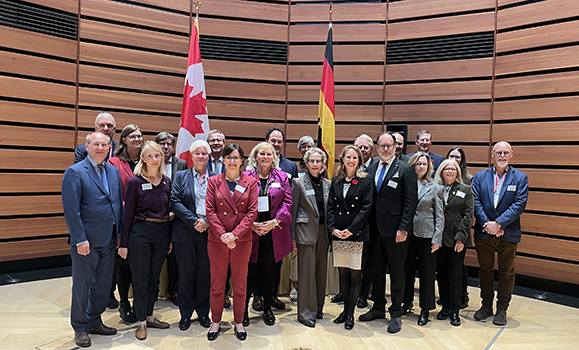
University leaders from Canada and Germany, including ÌÇÐĹÙÍø President Kim Brooks (front row, 3rd from left), met during Falling Walls. (Falling Walls Foundation photo)
ÌÇÐĹÙÍøhousie already has substantial connections to build on. Germany is ÌÇÐĹÙÍøhousie's fifth-largest international research collaborator, with 1,408 jointly authored publications between 2021 and 2026. Ìý
The declaration of intent with Fraunhofer offers an opportunity to further develop these research connections and tap into the power of the country's larger research model.
"The scale and organization of Germany's research ecosystem are striking," said President Brooks.ÌýÌý
The scale and organization of Germany's research ecosystem are striking.
She pointed to Fraunhofer and other major national research organizations there, including the Max Planck Society (fundamental research), the Helmholtz Association (infrastructure and mission-oriented research), and the German Research Foundation (competitive research funding), as amplifiers of work happening in universities.ÌýÌý
"These organizations provide different but complementary ways of organizing scientific capacity. They create opportunities to assemble research talent, infrastructure and industrial partnerships at a scale that individual universities cannot always achieve," she explained.ÌýÌý
Showcasing applied research
Various panels and other activities throughout the weekend centred on Canada's role as a leading research partner, including a discussion on the governance of dual-use research and emerging technologies featuring President Brooks. Ìý
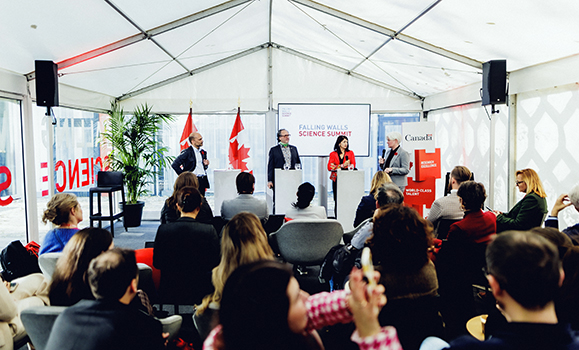
The panel, moderated by Nipun Vats, Assistant Deputy Minister for Science and Research at Innovation, Science and Economic Development Canada, centred on the question of how universities and governments can manage legitimate security risks without unnecessarily restricting scientific collaboration.
 Ìý
President Brooks, far right, during the Dual-Use Governance panel. (Falling Walls Foundation photo)
President Brooks shared examples from ÌÇÐĹÙÍøhousie such as its work in ocean observation, autonomous systems and AI to illustrate how the same underlying research can contribute to environmental protection, industrial innovation and national security.Ìý
"Sovereignty is not simply about controlling technology. It is about developing the scientific, technical and institutional competencies that allow a country to make meaningful choices about its future," explained President Brooks in reflecting on the perspectives she shared.Ìý
Elsewhere at the summit, ÌÇÐĹÙÍøhousie biomedical engineering master's student Linh Tran showcased a powerful example of applied research with her pitch, "Breaking the Wall of Sample Volume: Big Diagnostics from Tiny Volume.â€� She was one of 100 young scientists invited to compete in the Emerging Talents category, having earned a spot on stage in Berlin by winning the 2026 Falling Walls Lab Atlantic Canada competition in September.Ìý
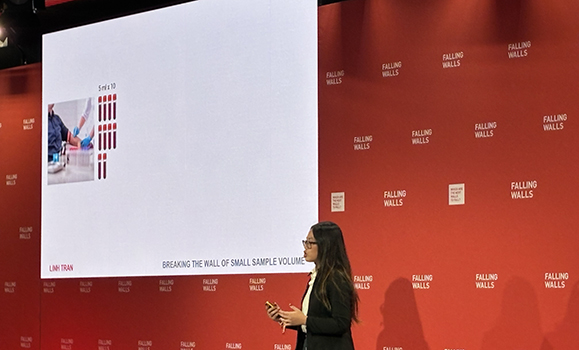
Linh Tran delivers her presentation at Falling Walls.
Tran’s research centres on development of a tool that enables medical professionals to glean more information from smaller blood sample sizes — an advance that makes it easier to get readings from patients typically difficult to draw enough blood from, such as infants or the elderly.
Learn more about her research in this Q&A
A broader horizon
President Brooks said she is excited for what lies ahead with ÌÇÐĹÙÍø's partners at Fraunhofer and sees other new opportunities for ÌÇÐĹÙÍøhousie on the horizon, some building on existing collaborations and others exploring new partnerships.Ìý
"I leave Berlin encouraged by the interest in working with Canada,â€� she said, “and by the recognition among international research leaders that universities have an essential role to play in a changing geopolitical and economic environment."ÌýÌý