

It's the mid-1990s, and while youth engineering and science camps are taking off in big cities across Canada, Nova Scotia has yet to catch on. Curious about the trend, Halifax-based engineering student Jon MacConnell heads out of province to check one out.Ìý
He returns inspired, gathering support from ÌÇÐĹÙÍøhousie’s dean of science, Nova Scotia’s minister of education and others to launch in 1996 with four instructors, various Halifax school workshops, and a lot of hope. Ìý
Three decades later, SuperNOVA continues to carry MacConnell’s vision forward, expanding access to STEM education and creating opportunities for youth across Nova Scotia. Only now, it’s bigger and more ambitious than ever. Ìý
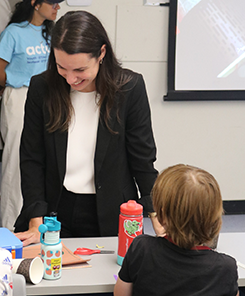 “Our reach has changed, and we’ve been able to develop new programs, like ones focused on climate change and AI,â€� says Maya Potter, acting executive director of SuperNOVA. “You have to remain flexible and responsive to current needs and priorities within education.â€� Ìý
Shown left: Maya Potter.
SuperNOVA recently launched its , a fundraising campaign aimed at expanding access to programs that build confidence, spark curiosity, and foster belonging in STEM.
Potter says ÌÇÐĹÙÍøhousie has played a pivotal role in supporting SuperNOVA since its inception, helping the organization transform from a single week-long engineering camp to reaching more than 30 communities in Atlantic Canada.Ìý
“We continue to be supported by the university, and there is a great opportunity to work here with professors or researchers. It is a really great way for youth to meet potential role models or see themselves in future STEM careers,â€� says Potter. Ìý
Changing environment, same purpose
She adds that since SuperNOVA began at ÌÇÐĹÙÍøhousie, the group’s mandate — investing in the future of youth — continues to anchor its work. Ìý
The organization now connects with more than 15,000 youth every year, many through its popular summer camps hosted at ÌÇÐĹÙÍøhousie. Ìý
Ikenna Chinye, a current ÌÇÐĹÙÍøhousie student, says the programs helped build his knowledge. Ìý
“What drew me was how interesting the activities were,� says Ikenna, who attended SuperNOVA as a camper in 2017. “I kept asking to go over and over again.�
I kept asking to go over and over again.
This past summer, he worked as an instructor in the organization’s engineering camp, giving back to the program that helped inspire him.
 Ìý
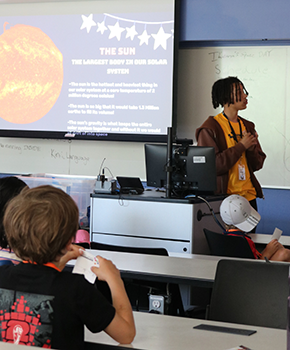
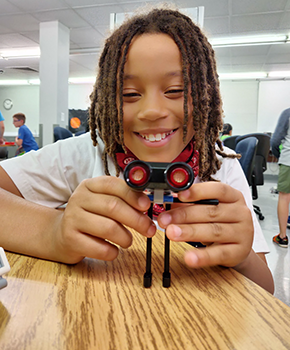
Ikenna, pictured as a camp participant in 2017 (left) and as an instructor in 2026 (right).
These types of stories are common within SuperNOVA, which now employs 11 full-time staff Ìýand 40+ seasonal instructors, most of whom are from ÌÇÐĹÙÍøhousie. Ìý
Mira MacNeill, a ÌÇÐĹÙÍøhousie Computer Science alumni, attended SuperNOVA’s summer camps and girl’s programming as a child. Today, she is one of the group’s full-time program coordinators, organizing the same programs she used to attend.Ìý
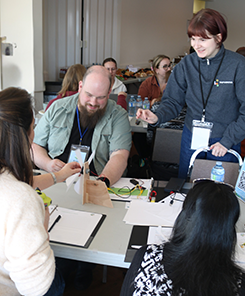
“I was always interested in science. My dad is a programmer, so I grew up around science as a kid, which is why my parents sent me to SuperNOVA,â€� says MacNeill.Ìý
Shown right: Mira MacNeill.
But SuperNOVA’s program opened her eyes to a range of different science she didn’t know much about. “I cared about science, but SuperNOVA made me care more,â€� she says. Ìý
Potter says the culture within SuperNOVA, along with its dedication to inspiring youth, is what Ìýencourages people to return. Ìý
“It offers an opportunity to be creative, to work with like-minded people. Being able to inspire Ìýyouth directly and be part of their STEM journey, when we’ve all had our own STEM journeys, Ìýcan be really meaningful, and fulfilling’, she says.Ìý
Empowering new leadersÌý
MacNeill says working with SuperNOVA has offered her a chance to apply her previous experience along with her degree to support the next generation of students. She explains how Ìýthe programs go deeper than just education, giving children a foundation for future scientific endeavours.Ìý
“We put a lot of care into the content, making sure it is educational but also fun. We allow students to bring themselves into it,â€� says MacNeill.Ìý
We allow students to bring themselves into it.
As SuperNOVA’s 30th anniversary year comes to a close in 2026, the group is focused on fostering its relationships to build even more responsive programming that minimizes barriers to education such as travel.Ìý
“Barriers can take shape and look different in each person, and that’s where we try and ground our work, instead of a one-size-fits-all approach,� says Potter. “We want to continue providing these opportunities that show you the possibilities there are for the future.�